
Request a call back!
For any questions or to arrange a consultation appointment:
Please fill in our form and our colleague will call you back at the time you indicated!
A successful hair transplant begins with planning
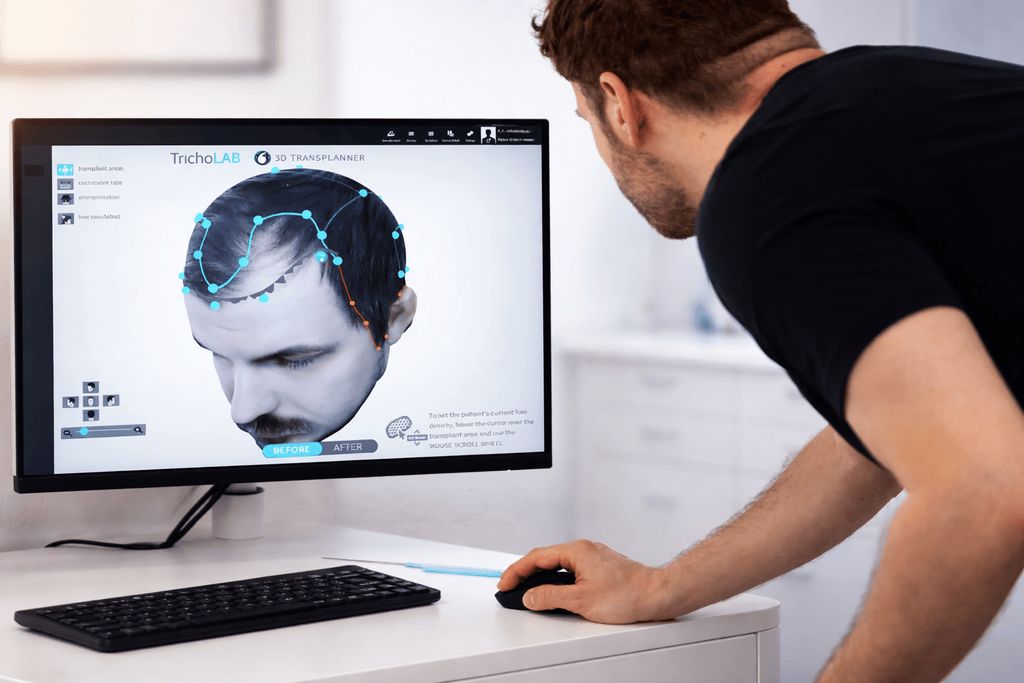
A successful hair transplant does not begin in the operating room, nor does it depend on a single instrument. First, the existing hair, the donor area and the pattern of hair thinning must be assessed, and only then can the naturally-looking hairline, the required number of grafts, and the proper distribution of the grafts be planned.
Modern technology can really add a great deal to the process when it supports the precise execution of a plan built on a detailed assessment. In HairHungary's system, this approach is combined through TrichoLab 3D planning and the Trivellini FUE hair transplant.
What is needed for precise hair transplant planning?
Every patient arrives with different starting characteristics. Hair density, hair strand thickness, the extent and pattern of thinning, and the donor hair that can be safely used can all differ.
That's why the pre-hair-transplant consultation and assessment during, the planning is preceded by a personal examination. We assess the condition of the hair and scalp, the nature of the hair thinning, as well as the characteristics of the donor and recipient areas.
Reviewing the medical history, medications, and other relevant factors is also an important part of the preliminary assessment. The goal is to determine whether the given patient is suitable for a hair transplant, what options are available, and what long-term plan may be realistic in their case.
When designing the hairline, a sense of proportion and long-term planning are especially important. A hairline that is too low or too uniformly regular can later look unnatural. It's not simply about drawing an aesthetically pleasing line: the hairline should be designed to fit the character of the face, the expected progression of hair thinning, and the available donor supply.
The possibility of a natural result is therefore already significantly influenced, before the surgery, by how precise and how sustainable in the long term the plan is.
What does TrichoLab 3D planning add?
A TrichoLab 3D hair transplant planning it helps ensure that the surgical plan is based not solely on visual assessment and estimation, but also on measurable data.
During the examination, hair density, the thickness of the hairs and their variation by area, among other things, can be assessed in more detail. Analysis of the donor and recipient areas helps determine, besides the individual's characteristics, what graft quantity and graft distribution may be warranted.
This is especially important because the donor supply is finite. The goal is not simply to extract as many grafts as possible, but to use the available donor hair in a way that takes long-term possibilities into account alongside treating the current hair loss.
Digital planning can also make the process more transparent for the patient. Rather than just seeing a hairline drawn on the scalp, they can better understand how their own hair, their donor capacity, the planned hairline, and the required number of grafts all connect.
The documented starting condition can also serve as an important basis for comparison during later check-ups.
A good plan must also be implemented with precision
Detailed planning must be followed by precise surgical execution. This is where the method used at HairHungary Clinic plays a role, namely the Trivellini FUE hair transplant.
During FUE hair transplantation, hair follicle units are extracted one by one from the appropriate donor area. The Trivellini system's extraction parameters can be adjusted to individual hair and skin characteristics, which supports precise graft extraction and gentle treatment of the donor area.
Precise execution is also important because the donor supply is not unlimited. Every usable graft has value, which is why the donor density, even extraction, and the possibility of future hair transplants must all be taken into account already during extraction.
However, a natural-looking final result is not determined by a single technology or tool. What matters is the design of the hairline, the available donor supply, the distribution of the grafts, achieving the right density, and following the natural growth direction and angle of the hair.
A hair transplant before-after results can clearly illustrate how proper planning and execution come together in practice.
TrichoLab and Trivellini: two separate tasks, one common plan
TrichoLab 3D and Trivellini FUE are not technologies that replace one another. They come into play at different points in the same process.
TrichoLab, the a detailed assessment and the planning of the hair transplant supports. The Trivellini FUE system, in turn, plays a role in the precise surgical execution of the plan.
The two are connected by a personalized surgical strategy: assessment → planning → implementation → follow-up.
So the technology is not used in the process for its own sake. The goal is to know the starting condition as precisely as possible, to create a realistic plan based on individual characteristics, and then to carry it out during surgery as precisely as possible.
The result of the hair transplant begins already at the planning stage
With a hair transplant, it's not only necessary to examine where the hair is currently missing. It also needs to be considered what donor supply is available, how one's own hair may develop over the coming years, and how the finite donor supply can be used so that the result remains natural-looking in the long term.
That's why, in HairHungary's approach, surgery is not a standalone event but a carefully planned process.
If you would like to find out what options are available to you, request a personalized hair transplant consultation, where we can discuss the possible next steps based on your own hair and donor characteristics.