
Request a call back!
For any questions or to arrange a consultation appointment:
Please fill in our form and our colleague will call you back at the time you indicated!
How do clinics that perform hair transplants classify patients?
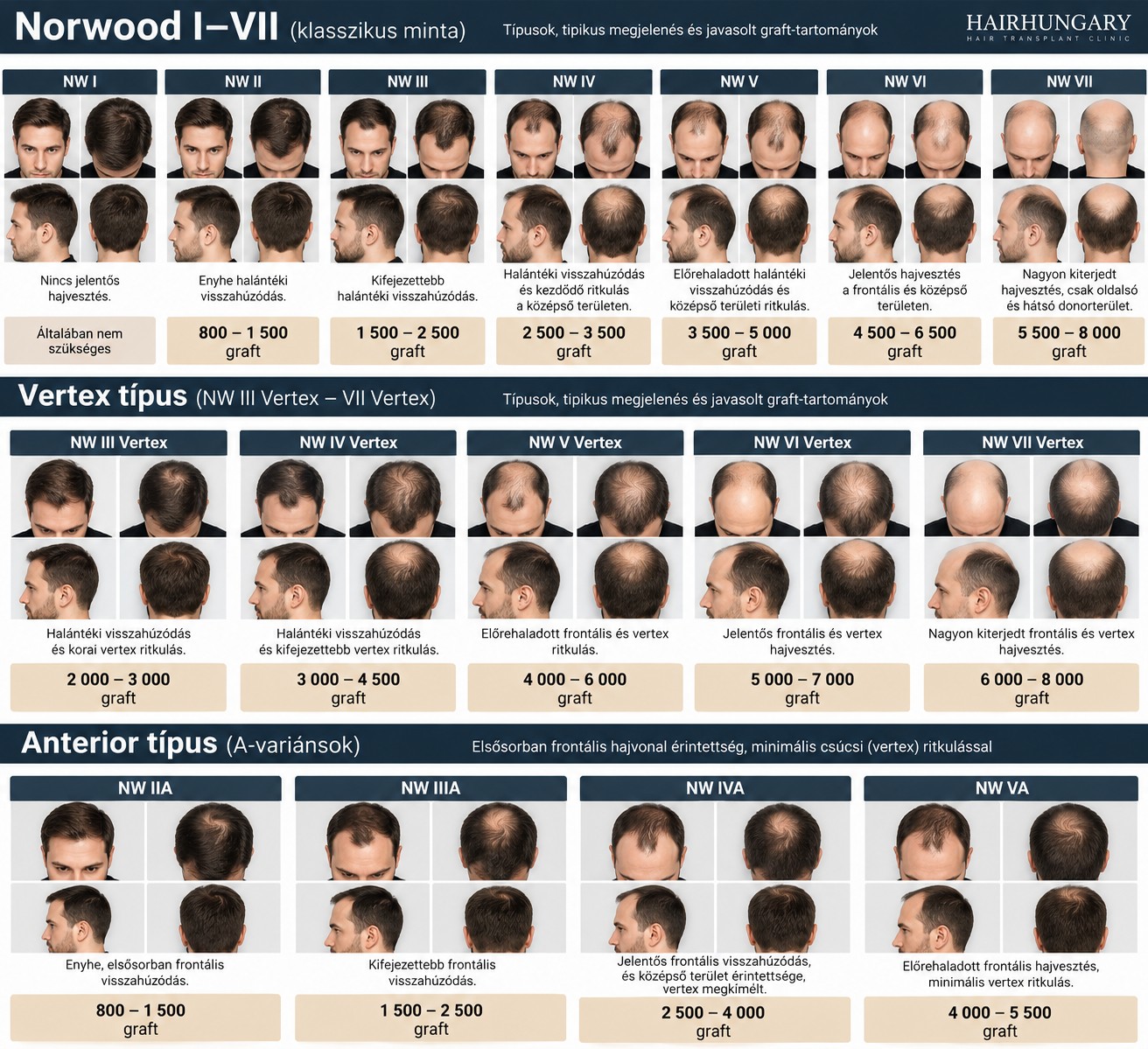
You're probably curious about what classification system hair-transplant clinics use to categorise the patients who come to them. There are two internationally recognised systems that help determine how advanced the stage is when people affected by hair loss come to us, and how we treat it. Male and female hair loss develop for different reasons, so we use two different scales depending on gender. Since no two people are identical, there are no two identical scalps in the world either. This post, however, can serve as a useful guide for those who want to assess, from the comfort of their own home, which category their degree of hair loss falls into.
Male-pattern hair loss - The Norwood scale
Hair loss affects both sexes. However, in our experience, genetic balding in men is the most common case. This is why, in 1975, Dr. O'tar Norwood created his classification scale, which has since become the most widely used. We can only talk about a Norwood classification if beforehand it is certain that androgenetic alopecia, or by its newer name, male-pattern hormonal hair loss we determine. If it is not hereditary hair loss, but the crown is thinning due to, for example, improper nutrition or other causes, the degree of hair loss cannot be classified so uniformly. The scale defines two main patterns, the general pattern and the Norwood Class A pattern. There is also a less common third category, known as diffuse pattern hair loss and unpatterned alopecia, but since it occurs infrequently, we will not go into it here.
The general Norwood pattern
In what can be considered the most common pattern, hair loss begins in two different areas: at the temples and at the vertex. Over time, these areas enlarge and gradually merge until the entire front, top, and crown (apex) of the scalp become bald. The term vertex refers to the area at the back of the scalp where the hair forms a whorl - where hair often begins to thin even at a young age - in other words, the crown of the head. The general Norwood pattern of hair loss is divided into two stages. Since hair loss is a continuous process, many patients fall into overlapping categories.
- Norwood Class I: Juvenile hairline, whose hairs typically rest along the upper forehead crease. It does not indicate balding.
- Norwood Class II: A mature hairline, where solid progression of the two temporal triangles can be seen. It is roughly one finger's width higher than the upper forehead crease. It does not indicate balding, but rather represents a mature hairline.
- Norwood Class III: The earliest stage of hair loss. This is where thinning of the hair on the crown begins. Early stage III hair loss is best treated with non-surgical therapies or with a hair transplant. This is especially true for younger patients.
- Norwood class IV: It is characterized by growth of the vertex area and recession of the frontal area, but the strip of hair acting as a dividing line on top of the scalp is still visible.
- Norwood Class V: In this class, the hair band begins to thin, and the bald areas of the vertex continue to expand.
- Norwood Class VI: Class VI includes those in whom the hair bridge disappears completely and a single large bald area forms from the front of the scalp to the crown.
- Norwood Class VII: In the most advanced stage, only the "horseshoe" remains on the back and sides of the scalp, since this area can effectively resist DHT overproduction.
Norwood Class A
The Norwood Class A pattern is characterized by hair loss progressing from front to back. In Norwood Class A, there is a single continuous balding area. When hair loss extends to the crown, the balding area is generally more limited than in the standard Norwood classes.
Norwood Class A patterns occur less often than typical patterns, but because the hair loss is most dramatic at the front, patients look balder even when the hair loss is otherwise minimal. Men with Class A hair loss often seek surgical hair restoration early, since the frontal bald area responds less well to medication, and the dense back and sides create a contrast that emphasizes the baldness on top.