
Request a call back! Please fill out our form and our colleague will call you back at the indicated time.
What can a thorough scalp examination reveal?
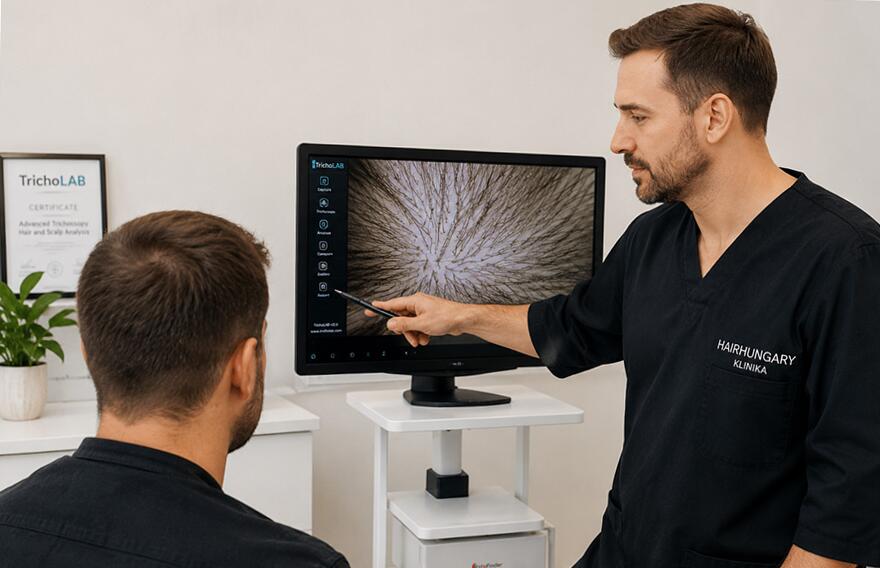
An important step in properly treating hair loss is a thorough assessment of your condition, because visible hair thinning on its own does not yet show its type, extent and possible cause. In the mirror we mainly see the consequences: the thinning hair, the widening parting or the gradually receding hairline.
A detailed, instrument-based examination of the hair and scalp, however, can also reveal abnormalities that are hard or impossible to see with the naked eye. This can be important not only in evaluating hair loss, but also in the precise and long-term planning of a possible hair transplant.
Why is the mirror not enough?
The sight of strands left in the drain after washing frightens many people, yet hairs fall out naturally every day, and the number of shed hairs alone does not necessarily indicate abnormal hair loss.
Hair thinning, by contrast, can go unnoticed for a long time and often becomes visible to the eye only after a significant loss of density. By then months, even years may have passed with the process gradually advancing. That is why many people feel the change is sudden, while the transformation of the hair has been going on in the background for a longer time.
An instrument-based examination of the scalp and hair can help recognize earlier the thinning of the hairs, the change in density and the characteristic pattern of hair thinning. You can read more about the signs of balding and the possible causes of hair loss in further articles of our hair transplant blog. You can read more about one method of instrument-based examination of the scalp and hairs on our Trichoscopic hair analysis page.
Not all hair loss is the same
There can be several types of hair loss, so behind two hair thinnings that look similar at first glance there is not necessarily the same process. The pattern of thinning, the thickness and density of the hairs, and the condition of the hair follicles can each provide important information for determining the right treatment direction.
When planning a hair transplant, a further important question is the condition of the donor stock. The number of follicular units that can be relocated varies from person to person, and in every case we are talking about a limited reserve.
The hair follicles of the safe donor area used for hair transplantation are generally less sensitive to androgen-driven miniaturization, and after transplantation they largely retain the characteristics typical of the donor site. However, the thinning of your own, non-transplanted hair may continue later on. That is why the optimal treatment or surgical plan is not necessarily the same for two patients, even if their hair thinning looks similar at first glance.
What do we examine during the TrichoLab assessment?
During HairHungary's TrichoLab 3D hair transplant planning we do not merely look at the hair, but assess in detail the current condition of the hair and scalp. Among other things, the density of the hair, the thickness of the hairs and their differences from area to area, and the degree of miniaturization can be examined.
When planning a hair transplant, special attention is given to evaluating the donor and recipient areas. The examination helps assess the density and quality of the donor area, and estimate, given individual characteristics, how many grafts can be harvested so that the aesthetic condition of the donor area can be preserved in the long term as well.
We also evaluate the thinning areas in detail: the hairline, the crown and the condition of the affected hair. This data helps ensure that the required number of grafts and their distribution can be planned not on mere estimation, but on a more detailed assessment of your condition.
Planning can also be helped by showing the results of earlier hair transplants and procedures performed with different graft counts, so the patient can get a more realistic picture of their own possibilities.
The donor stock is finite - so you have to plan for the long term
The donor area must be used sensibly. We always plan the required number of grafts taking into account the desired result, the size of the recipient area, the capacity of the donor stock and the expected later hair loss.
This matters because the thinning of your own, non-transplanted hair may continue later, so in some cases another procedure may become necessary years later. Excessive use of the donor stock, however, may limit the options for a later hair transplant.
That is why, already when planning the first hair transplant, not only the current hair loss but also the long-term possibilities must be taken into account. We document the condition of the donor area after the procedure as well, so the available donor stock remains assessable later on.
From precise assessment to precise hair transplantation
The results of the assessment also play an important role in planning the hair transplant. Based on the information obtained with TrichoLab, the surgical strategy can be determined, and the extraction and placement of the grafts can then be planned accordingly.
In the Trivellini FUE hair transplant used at the HairHungary Clinic, the parameters of follicular unit extraction can be adapted to individual hair and skin characteristics, which supports precise graft extraction and gentle treatment of the donor area.
Until transplantation, the extracted grafts are stored in a special solution containing liposomal ATP, the purpose of which is to support suitable conditions for the follicular units in the period between extraction and implantation.
The aim of the regenerative treatment complementing the surgery is to support the regeneration of the scalp and - with appropriate indication - the existing, still functioning hair follicles.
For more than ten years HairHungary has followed the same medical approach: every single transplanted hair graft is a separate surgery. That is why, at every step from planning through graft extraction to implantation, we place the emphasis on precision and individual characteristics.
Find out what options you have!
A few shed hairs on their own do not yet reveal what is happening with the hair. When planning a hair transplant, however, it is key to know the condition of the donor stock and how much reserve is available.
The donor stock is a finite resource, so even the first hair transplant is worth planning for the long term.
If you would like to learn more precisely the current condition of your hair and donor area, request a personalized hair transplant consultation at the HairHungary Clinic!