
Request a call back! Please fill out our form and our colleague will call you back at the indicated time.
How many grafts are needed for a hair transplant? Why guessing is not worth it
The number of grafts needed is often one of the first questions when someone is thinking about a hair transplant. That is understandable, since it would be good to know in advance how large a procedure will be required. A graft count found on the internet or a generic table, however, says little about what can actually be achieved in the given patient's case.
Planning requires determining not only how large an area we want to transplant. We must know the existing hair stock, the properties of the hairs, the desired density, and how many grafts can be safely extracted from the donor area.
What is a graft, and why is it not the same as a hair?
A graft is a follicular unit prepared for transplantation, which can contain one or more hairs. Therefore, for example, 2,000 grafts do not mean 2,000 hairs: the actual number of transplanted hairs can be even higher.
This matters because the result of a hair transplant is not determined by the number of grafts alone. The thickness, color and structure of the hairs, the number of hairs per graft and their distribution can all influence what coverage and visual density can be achieved.
If you are interested in the difference in more detail, in a separate article we explain what a graft means and how it differs from a hair and a hair follicle.
When planning a hair transplant, the size of the bald or thinning area, the condition of the existing hair and the quality of the donor stock also count. For two hair-loss areas of similar size or shape, a quite different graft count and surgical plan may therefore be justified.
What determines how many grafts are needed?
A smaller temple correction and the treatment of more extensive hair loss can involve completely different graft requirements. It also matters whether the goal is to create a new hairline or to optically improve the density of existing, thinning hair.
The required number of grafts is determined by several factors together: the size of the area to be treated, the density of the existing hair, the properties of the hairs, the desired result and the available donor stock.
The capacity of the donor area, however, is finite. In addition, androgenetic hair thinning in your own, non-transplanted hair may continue to progress later. Therefore the aim is not to extract as many grafts as possible in one surgery, but to plan the donor stock for the long term.
Besides treating the current hair loss, it must also be considered how much donor stock it is advisable to preserve for a possible later procedure.
TrichoLab measurements help determine the graft count
A preliminary picture of hair thinning can be formed from photos, but a more detailed assessment of your condition is needed for a precise surgical plan.
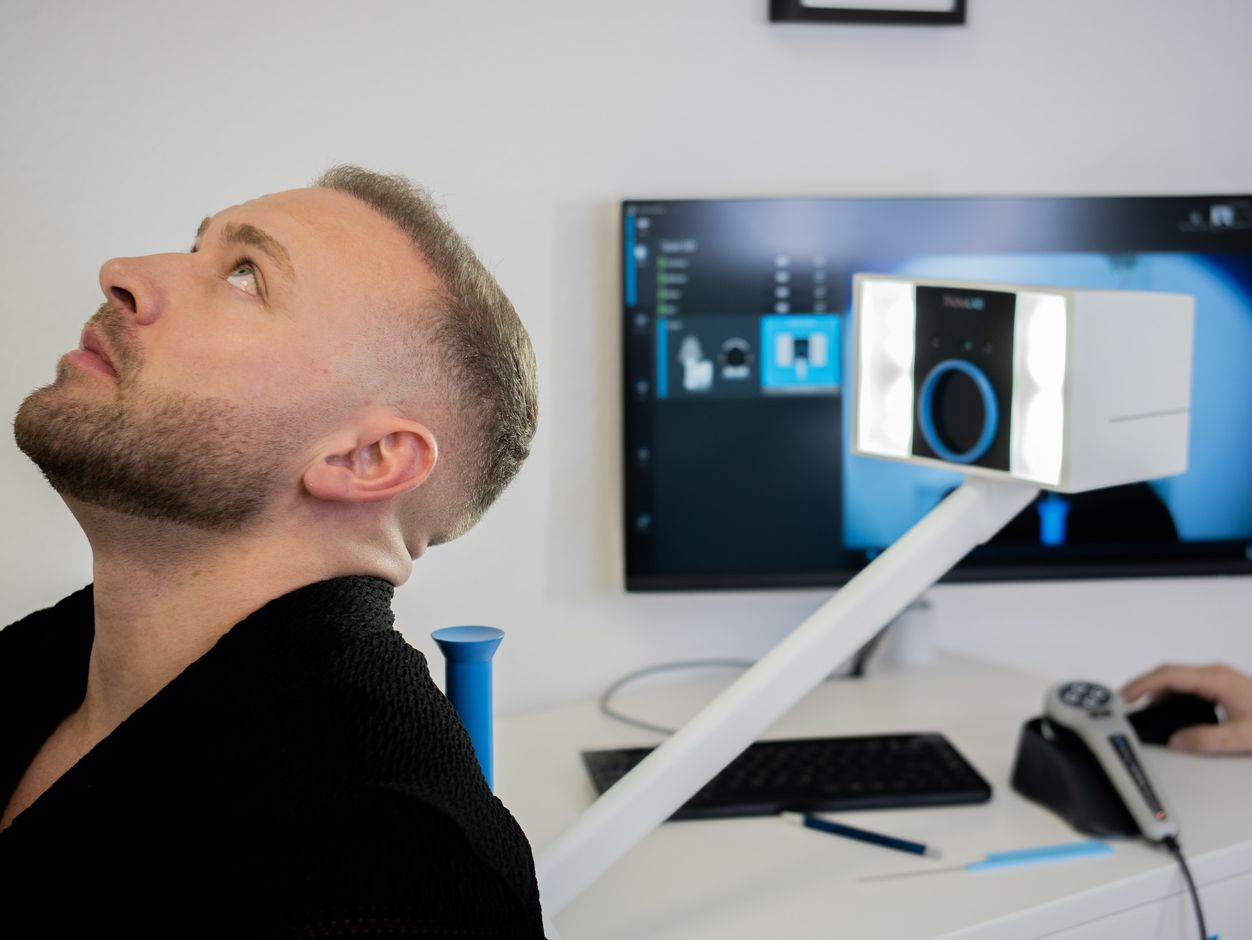
During HairHungary's TrichoLab 3D hair transplant planning we supplement the personal examination with measurable data. With the system, among other things, the density of the hair, the thickness of the hairs and their differences from area to area, and the condition of the donor and recipient areas can be assessed in more detail.
This information helps determine approximately what number of grafts may be justified for the given area, and how much of the donor stock can be used so that its aesthetic condition can be preserved in the long term as well.
The calculation, however, is not the job of an instrument alone. The measured data must be compared with the patient's characteristics, the expected progression of hair thinning and the result to be achieved.
Someone may primarily want to restore their hairline, while for another person thinning on the crown is the bigger problem. If the available donor stock does not allow treating all areas at the same density, priorities must be set.
That is why there is no "ideal graft count" valid for everyone.
Graft extraction is part of the plan too
Once we have determined approximately how many grafts are needed and can be safely used, the next important step is their precise extraction.
In the Trivellini FUE hair transplant used at the HairHungary Clinic, the parameters of follicular unit extraction can be adapted to individual hair and skin characteristics. The system also supports tracking the number of extracted grafts during the procedure.
The device on its own, however, does not determine how many grafts are needed, nor where they should go. That requires a personalized plan prepared before the surgery.
To create a natural effect, the shape of the hairline, the distribution of the grafts, the implantation density, and the natural growth direction and angle of the hairs must also be taken into account.
Why does the distribution of grafts matter so much?
The same graft count can give a different result depending on how large an area and in what distribution it is used.
In shaping the hairline, for example, a natural transition is especially important, while for a larger area on the crown a different density and distribution strategy may be justified. The available grafts are therefore not simply "spread out" over the hairless area.
The aim is that, with a distribution adapted to individual characteristics and priorities, a natural-looking result can be created from the available donor stock.
The before-and-after results of hair transplants can also illustrate well what change can be achieved with different starting conditions and graft counts.
The right graft count emerges from the individual plan
To the question "how many grafts are needed?", a single number therefore does not give an adequate answer. It is just as important to know which area we want to treat, what density can be achieved, what the donor stock allows, and how much reserve is worth preserving for the future.
That is exactly why, in the pre-transplant consultation, it is worth determining not only the expected graft count. Together with the patient we must also discuss which areas take priority, how the grafts are distributed, and what result can be considered realistic with the given donor stock.
The graft count becomes truly useful data when we also know why exactly this number of grafts is needed, where they can be safely extracted from, and how we use them.
The required number of grafts is unique for everyone, so a precise answer can only be given after assessing the hair stock and the donor area. Request a callback, and our colleagues will help with the next step!