
Request a call back! Please fill out our form and our colleague will call you back at the indicated time.
The Natural Hairline, Part 1
During consultations our doctors have countless times faced requests that simply concern the natural reconstruction of the hairline.
Our patients do not only come to us with complete baldness; often they just want to restore the youthful hairline that has disappeared from the front. In the following two-part article we present the professional principles and techniques we work by, so that our results reflect the most natural effect possible, as can also be seen below.
For more results and visible hairline changes, click the following button:
This article discusses the basic visual characteristics of natural hair and the techniques used to reproduce them. In addition, in the second part of the article we present a systematic, novel approach to the consistent creation of natural hairlines. Part two: The natural hairline, part 2
Creating the natural hairline
With the advance of medicine, we too are better prepared to create hairlines that meet the higher expectations placed on us. This is partly thanks to the more natural, finer-structured follicular units (FU) used in greater numbers in the hair region.
FUs have given us new possibilities with which we can easily create a new hairline. On the other hand, an equally important consideration was a better understanding and recognition of the visual characteristics that make up normal hairlines.
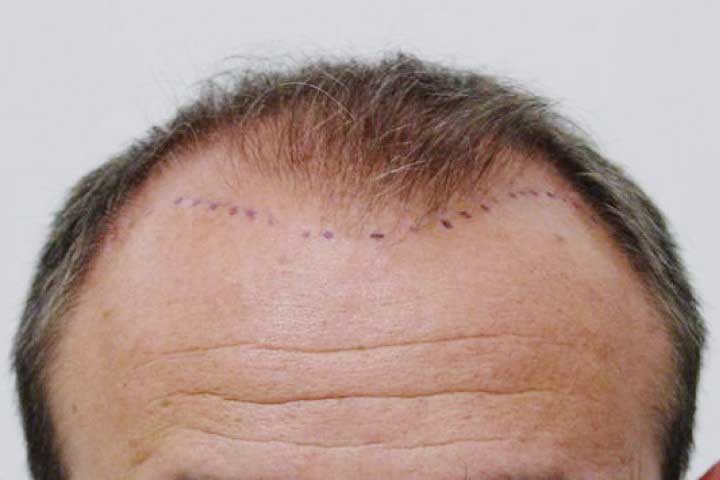
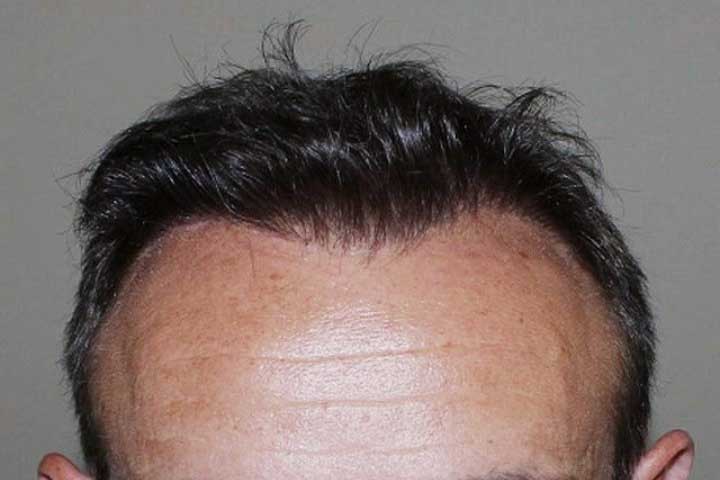
The new hairline is drawn first during the consultation (left) and second at the start of the day of surgery (right)!
The picture above shows our patient’s consultation from another angle and the result 9 months later after what can be called minimal densification.
The ability to create a natural hairline has always been one of the most important elements of a successful hair transplant . The ability to create a natural hairline has grown dramatically over the years, and as a result many promise full and natural hairlines in their promotional materials.
It is no wonder that patients’ expectations have risen over time. Simply because the easier-to-manage FUE (Follicular Unit Extraction) method is now available to most clinics does not mean that using it equals creating a natural hairline. For that we must also understand how nature forms it and how exactly this critical area is built up.
The three regions of the hairline
There are numerous excellent articles on hairline design. Most, however, concentrate only on the very front edge of the hairline, usually called the transition zone. By contrast, we find it useful to imagine the hairline as a larger, more extensive region, about 2-3 cm deep, which connects the bald forehead with the area of central density.
The extended hair region mentioned above can be divided into three smaller zones: the front part, whose name is the traditional transition zone. The rear part is called the defined zone and a small oval area in the middle of the defined zone is the so-called frontal forelock. All three zones contribute uniquely to the overall appearance of the hairline.
In part 2 of The Natural Hairline we examine these three regions further and explain what can be used to determine the naturalness and density of the future hairline. Stay tuned!
Are you interested in a hair transplant?
Feel free to contact us at +36-30/552-0940 or request a call back by clicking the button below!