
Request a call back! Please fill out our form and our colleague will call you back at the indicated time.
In short: the severity of female hair loss is described by the three stages (I–III) of the Ludwig scale. In women, hair loss typically shows up as diffuse thinning across the top of the scalp rather than bald patches. A hair transplant is usually an option in stage II, if there is enough donor hair at the sides and back of the head; in stage I it is not yet justified, and in stage III there is often too little donor hair.
The female ideal has changed with the ages, but there has always been one common denominator: hair. Thick hair is an undisputed element of female beauty and, like the width of the bust and hips, the human brain associates it with fertility. Look at today’s advertisements and almost without exception glossy, long-haired women draw our eye, while in reality female hair loss is becoming ever more common. A telling sign can be the amount of hair left in our hands when combing or washing, and when we notice that the hair has become thinner and no longer holds as it used to, we inevitably get frightened. If you notice this over a longer period, it is worth considering what options there are against hair loss. Just to say in advance: there is a solution!
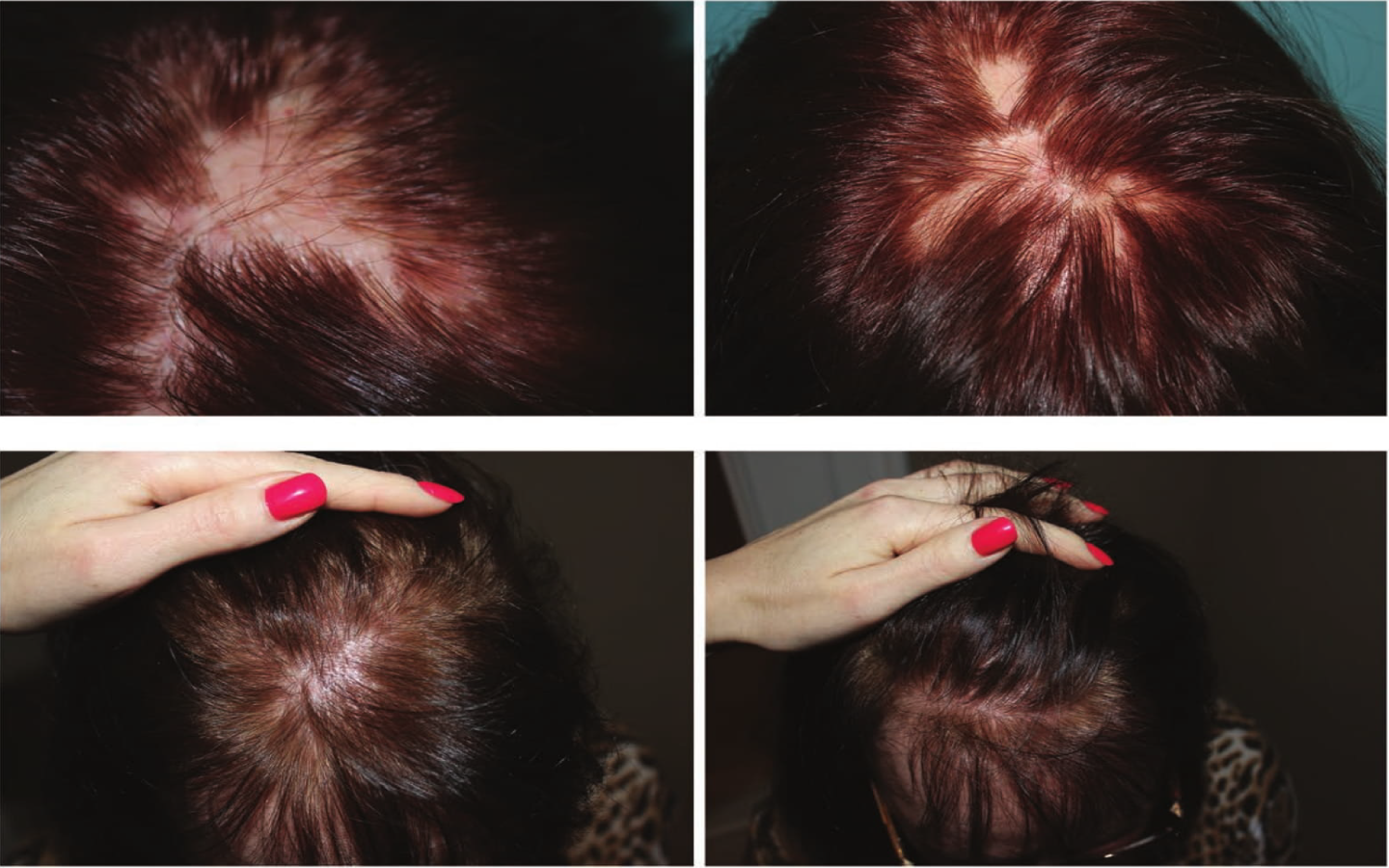
The picture (top left) shows mild type I hair loss, which our clinic treated with the transplantation of 800 grafts. An exact diagnosis naturally preceded the procedure, as hair transplantation is not suitable for everyone. In such cases we recommend various regenerative therapies, such as the medically proven, effective I-PRF treatment or mesotherapy treatments.
Hair loss is a serious emotional problem for both sexes, because deep down everyone is vain in a certain sense. Female hair loss can have many causes, and although it is most often caused by inherited genes, it does no harm to take a closer look at our lifestyle too. Medication, smoking, the period after pregnancy or other life stages that affect the hormonal balance all contribute to the phenomenon. It is important to note that just as no two people are alike, no two scalps are identical. This post can, however, serve as a guide for those who want to assess from the comfort of home which category their hair loss falls into. Male hair loss is somewhat more complex in terms of scaling; you can read about it on our male hair loss scale page, or the video below may help.
(Subtitles are available via automatic translation)
Playing this video connects to YouTube.
Female hair loss – the Ludwig scale
Female hair loss is very different from male hair loss, as women react less readily to hormonal changes. Both oestrogen and androgen hormones are present in the female body, with oestrogen normally predominating. However, androgenic hair loss can also affect women, since the enzyme 5-alpha-reductase can just as well convert testosterone into DHT (dihydrotestosterone), the hormone that inhibits the growth phase of hair follicles. It is possible that in women with this type of hair loss the hormone levels (even the androgen levels) are completely normal, yet the enzyme mentioned above suppresses the oestrogen level responsible for hair growth.
Another important difference between the hair loss of the two sexes: in men, an overproduction of testosterone can cause hair loss, whereas in women it is caused by a drop in oestrogen levels or by tissue sensitivity to sex hormones. This is why it typically occurs around the menopause. Interestingly, bald patches like those in men do not develop; instead, a general thinning of the hair and a thinning of the individual hairs is characteristic.
The three stages of the Ludwig classification
The Ludwig classification consists of three stages describing genetic female pattern hair loss:
- Type I (mild) – Early thinning of the hair, which can still be easily disguised with the right styling. In this type not enough hair has fallen out yet for hair transplantation to be an option.
- Type II (moderate) – In women with type II hair loss the parting widens and the hair density on the scalp visibly decreases. Hair transplantation can be performed only if the patient has donor areas with stable hair at the back and sides of the scalp.
- Type III (extensive) – The top of the scalp becomes almost completely translucent, usually with thinning across the entire scalp. Patients at this stage often have too few donor hairs for a hair transplant to lead to adequate results.
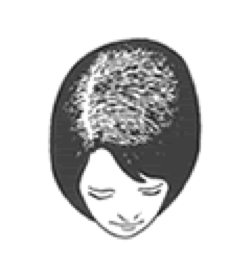
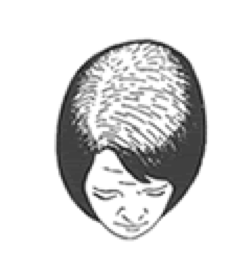
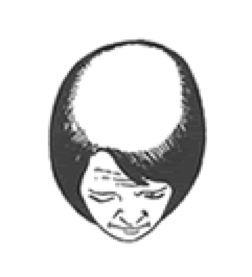
In all three Ludwig stages hair loss occurs on the front and top of the scalp, with the frontal hairline relatively preserved. Women experiencing hair loss should obtain as accurate a diagnosis as possible, preferably from an experienced dermatologist. This is especially important because the diffuse hair loss typical of women can occasionally be caused by a number of treatable conditions. Regardless of the extent or cause of the hair loss, only women with a sufficient amount of hair at the back and sides of the scalp are suitable candidates for hair transplantation.
If you have any questions about the classification or about hair transplantation, please contact us using the button below!
Frequently asked questions about female hair loss
Frequently asked questions
What is the Ludwig scale?
The Ludwig scale describes three stages of female hair thinning. It assesses the loss of hair density at the top and front of the scalp while the frontal hairline is usually preserved.
When can women have a hair transplant?
In stage II, if there is enough donor hair at the sides and back of the head. In stage I the hair loss is not yet sufficient for a transplant, and in stage III there is often not enough donor hair for an effective result. More on our hair transplant for women page.
What can I do if a hair transplant is not suitable?
We recommend regenerative therapies such as I-PRF treatment and mesotherapy.
Why is an accurate diagnosis important?
Female hair loss differs from male hair loss and is often linked to hormonal changes, such as shifts in estrogen levels or hormone sensitivity of the tissue. That is why an accurate diagnosis by an experienced specialist is needed; trichoscopic hair analysis can help.
How can I book a consultation?
Request a callback or see our prices. Our clinic is at Montevideó utca 9, 1037 Budapest.